

contradiction loosens the mind
how to mutate your senses, part II

This is Part II of a series called how to mutate your senses. In Part I, I wrote about how our inherited frames are more than outlines; they are spheres that surround us. In Part II, we become the creator of these spheres, turning them into something we shape deliberately, rather than inhabit blindly.
contradiction as method
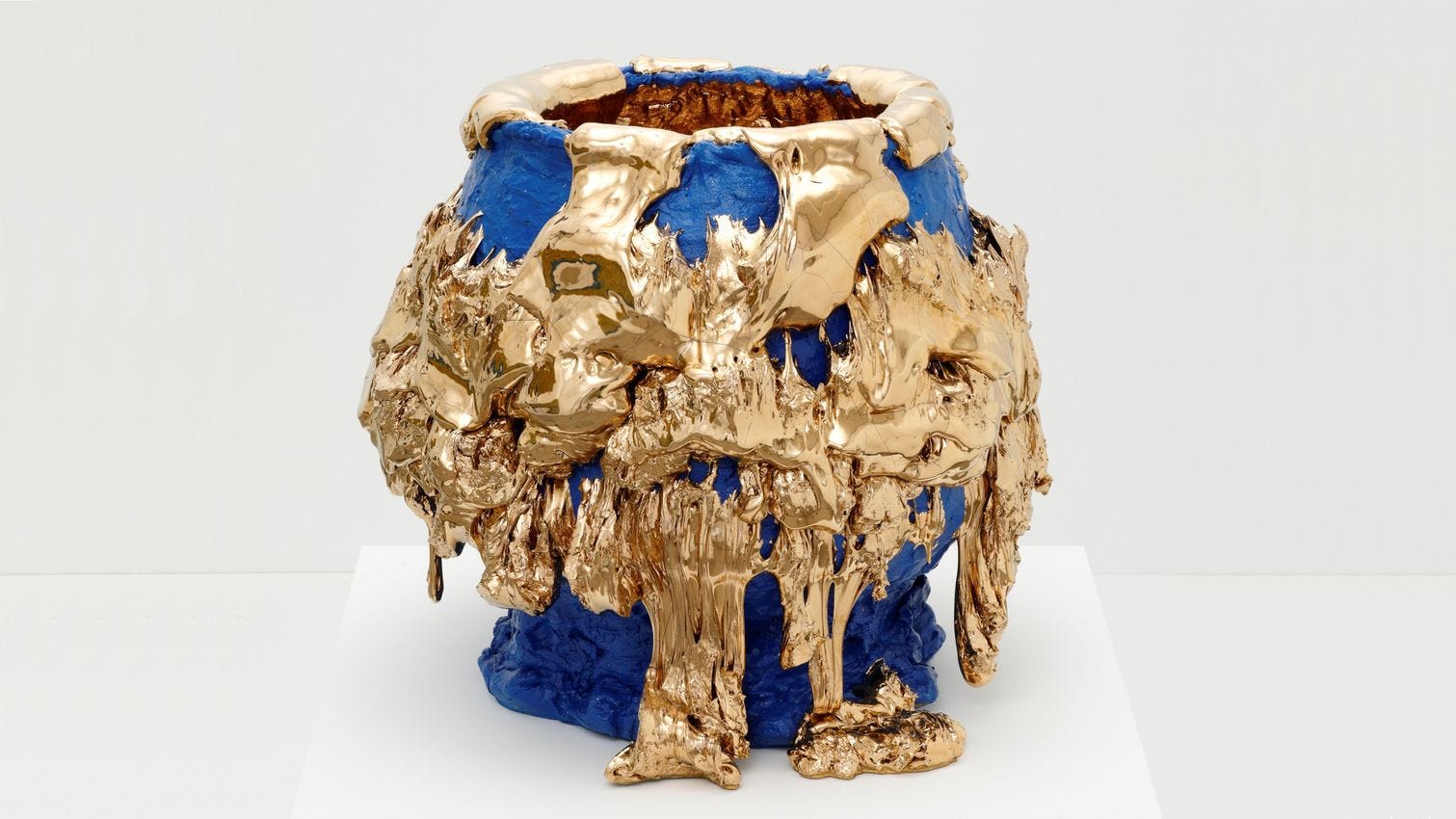
The sculpture is freckled with distortions, pulling it this way and that, as if it were a sheet of dough being kneaded by a pastry chef. Ishi-haze. That’s what I read on the small placard next to this creation that is brimming with aliveness. Literally “stone explosion”, it tells me that the sculptor adds oversized rocks to his kiln, urging them to explode and puncture the surface to form a unique design.
Takuro Kuwata buries contradiction in his kiln. Rather than letting the traditional ceramic technique form an expected shape, he flirts with the process, flicking stones into the furnace to see what rises to the surface of the vessel.
A frame, like a finished vessel, is smooth: nothing catches the eye or the hand. Our frames sand down the corners of our beliefs, removing the jagged edges that might pierce a hole in our conversations and relationships. Everything fits together seamlessly. When you plant a contradiction in that surface and apply heat, it erupts, fracturing the vessel. Those fracture lines gradually widen, exposing the original form of the piece.
As the philosopher of margins Simone Weil argues, “contradiction can be a generative obstacle in that it requires the mind to expand its thinking in order to transcend the obstacle.” Contradiction loosens the mind.
And once you transcend the obstacle, you can think over, under, above and beyond that obstacle. It evaporates. Contradiction awakens the senses to what we have come to expect from our landscape, while revealing what is possible with a little mutation.

contradicting our values
In modern society there is an invisible pressure to adopt a set of values and beliefs that cohere into a pixel perfect picture. If you support a political party, our bipartisan system demands that you absorb every single one of their policies and embrace them as part of your own philosophy. It is nigh on impossible to agree with certain policies and oppose others, while still feeling accepted by fellow supporters.
But the reality is that many of our values are contradictory. We are complex beings with multifaceted lives that manifest as a mosaic of values and beliefs. Some pieces of the mosaic are old and chipped. Others gleam boastfully. They do not share the same origins nor the same stories. They have found themselves nestled in our mosaic having travelled through the many intricate branches of our experience.
Deliberately putting ourselves in situations where our values contradict each other can act as a brake on our progress. When every part of our identity coheres, friction dissipates and we can move forward easily. If we feel like parts of our identity are fighting each other to figure out who comes out on top, we stutter and stall.
When I’m faced with a choice–for example, do I want to share my ideas publicly or limit my time online–two of my values are competing. One part of me wants to prioritise my sense of duty and ambition; I want to write and share my work so I can be in service of a marginally better world. Yet another part of me wants to prioritise the preservation of my mental wellbeing and attention span by refusing to be perpetually online. When faced with this choice every day, which of these two values do I allow to drive my decisions?
Forcing myself to answer this question forms a stone in the kiln of my mind, cracking my vessel. The frame I had inherited was that ambition and wellbeing are opposed. In this instance, I realise that these two options don’t have to be mutually exclusive. I can write online while implementing constraints that limit how much time I spend in the digital world. Much easier said than done, but certainly possible.
contradicting our instincts
Another way to plant stones in your kiln is to intentionally move against your instincts. A few years ago I was talking to a close friend as I was thinking about quitting my job. She chuckled and said: “What would Nikita not do in this situation? Maybe you should do that.”
I ended up not quitting for another six months, welcoming a season that was incredibly generative for me both personally and professionally. To deliberately–and somewhat painfully–move against my instinct taught me a lot about the narratives that had shaped that instinct.
This process feels like you’re opening up an intricate piece of origami that someone else has folded; each fold you undo reveals a new surface area, a previously unexplored possibility space that you didn’t know existed when the model was presented to you in its final form.
When you contradict your instincts, you ask yourself: what did the original piece of paper look and feel like? It’s like you’re telling your brain: I know this is what we usually do, but don’t freak out, we’re going to discover new ways of being together and we’ll be okay no matter what, promise. As Jackson Dahl puts it, it feels like “rejecting your mental immune system”.
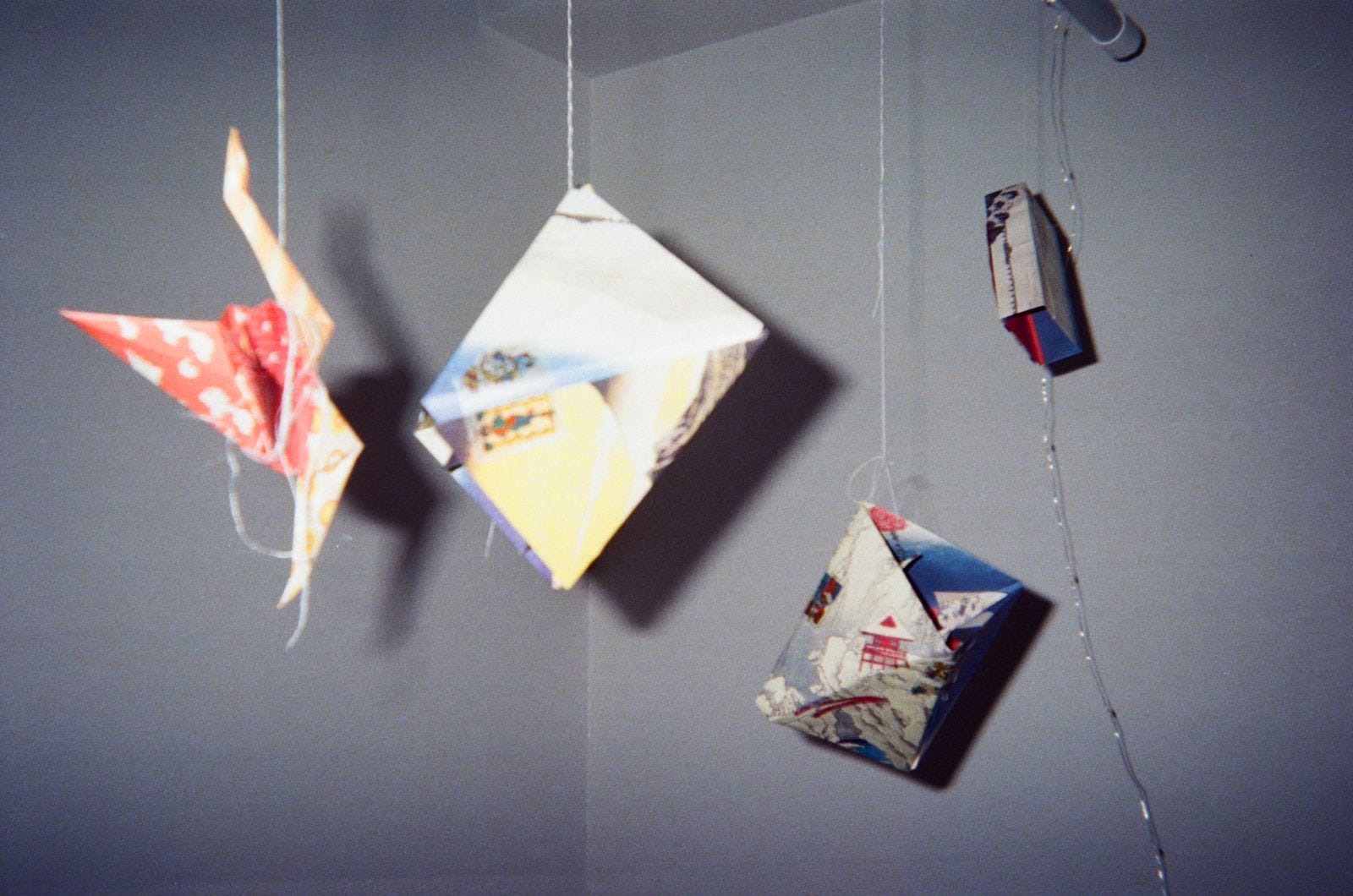
When I unfolded my origami, I realised my instinct to quit was driven by the realisation that the company was operating in a way that felt misaligned with my core values. Only hindsight could reveal to me that this instinct was driven by an irrepressible pursuit for perfection. By persevering for another six months, I hit new lows, but I also became acquainted with a depth of meaning that can only be reached by swimming deeper into the unknown and the uncomfortable.
contradicting our beliefs
In read weird books, I wrote about how choosing books that create friction in your worldview is a powerful way of developing empathy. This is also a meaningful way to mutate your senses and is true of all the beliefs and inputs we let flood our mind, including those inherited from our broader culture.
For example, one of the frames I inherited over the course of my education is that jobs are deterministic. In other words, they either exist or they don’t and you have no control over that fact. It took me six years in the job market, a lot of luck, and a huge amount of initiative to realise that jobs are actually nothing more than imagined entities: a bundle of tasks that someone needs to get done because of a particular goal they have.
I realised this because, of the five full-ish time jobs I’ve had, I only applied to one of them. I contradicted my inherited belief by refusing to accept that a job application was simply a way for me to get a job. Instead, I turned every application into an opportunity to create a solution for the organisation. I’d make ginormous Miro boards to visualise some research I’d done for the company; I’d share comprehensive frameworks that I’d built from the ground up just for them.
Creating and pitching a role instead of applying conventionally ended up getting me results 80% of the time. Recognising that “apply for jobs” was just a widely-accepted story about how the labour market functions loosened the grasp of my inherited frame. By paying attention to my actual experience in the job market and trying different tactics to secure roles, I built the capacity to contradict, and then counteract, the beliefs I’d inherited.
contradicting our senses
When we contradict our values, instincts and beliefs, we’re playing with our cognitive apparatus. But underlying these is our most fundamental frame: our senses.
Last year, I wrote about how our brains simply confirm or deny what we expect to see, instead of processing every intricate detail that surrounds us. This shows how deeply our senses shape our experience of the world.
I’ve been wearing glasses since I was five years old. Every morning, when I put in my contact lenses, my world shifts from blurriness to clarity. Crystal clear. I’m so used to this routine that I hardly register the distorted world that is my default. But occasionally, just before bed, I sit with the blurriness. Even if it’s just for five minutes, I quiet my vision and allow my other senses to creep in. My sense of touch, in particular, seems to kick into action. My hearing heightens. The world quivers. I am reminded that my crystalline vision isn’t real, it’s one of many ways of rendering of the world.
My short-sightedness is a perceptual toggle I can turn on and off whenever I wish. Subtracting a sense for an evening can be wildly disorienting, and just as expansive: blindfolding yourself, putting a clip on your nose, using earplugs. This is the most literal way to mutate your senses.
In some ways, this is similar to the experience I’ve heard parents have when their toddler starts exploring the world. Your child gifts you a new set of senses, and your entire world is refracted through them. Colours brighten. Their incessant questions remind you how little we know of the world. You realise humans are actually kind of weird. Contradiction of your everyday experience has once again loosened your mind.
balancing coherence with contradiction
Blind absorption and replication of society’s frames means that many of us are living in a way that is not aligned with our authentic desires and goals. The lack of free choice means we’re often experiencing life as an echo of the masses. By embracing contradiction as a method, by planting stones in the kiln of our mind, we can begin crafting new kinds of frames marked with our unique distortions, rather than merely inheriting them from our cultural conveyor belt.
It is not sustainable nor advisable, however, to exist in a constant state of contradiction. As I wrote about in choose friction over fiction, coherence is a soothing balm that helps us detect patterns in the world around us. We need it to function in society. So once the stone has distorted our frame, we must let the kiln cool and allow time for the shape to set before we plant more stones.
Thank you to my ever-exceptional friends AJ and Hanne for sharing feedback on drafts of this essay and contradicting me in the most loving of ways <3